Research
How Does ShipFinder Website Really Work? The Technology Behind Real-Time Ship Tracking

Nowadays, the realm of tracking and tracing has ceased to be a luxury since the element of time is vital in any given situation. ShipFinder and similar websites have now become an essential part of life and business for ship lovers, cargo owners, shipping workers and even laymen. But have you ever questioned how ShipFinder actually works? How do all those little vessels appear on the screen in real-time? What happens behind the curtains? The solution is a complex mix of Automatic Identification System (AIS) technology, data aggregation, GPS tracking, satellite feeds and intelligent mapping.
What is ShipFinder?
ShipFinder is a web-based and mobile app-based platform that provides real-time ship tracking around the globe. Whether it is a container ship, cruise liner, oil tanker or fishing vessel, ShipFinder gives details about the name of the ship, type, location, speed, course and even historical records including previous voyages. It becomes even more attractive due to its easy map interface that allows zooming in on a particular port or tracking a ship moving across oceans in real-time.
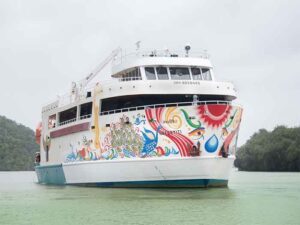
ship image
The Spine: Automatic Identification System (AIS)
The primary technology applied in the ShipFinder is AIS (Automatic Identification System). According to the International Maritime Organization (IMO), most large commercial vessels and a large number of smaller vessels must utilise AIS. Every AIS ship is fitted with a transponder that continuously broadcasts the information related to the shipname, position, course, speed etc.
These messages are collected by an international network of terrestrial AIS receivers (in coastal areas, ports and vessels themselves) and increasingly by satellite-based AIS receivers too. ShipFinder connects to these networks to capture AIS data in real-time and defragment them into valuable visual stories for users.
The Mechanism of Data Collection and Processing in ShipFinder
ShipFinder uses both volunteer-run AIS receiver networks and its own receivers, along with third-party satellite feeds to source AIS data. After collection, the data undergoes several processing stages:
- Data Cleaning: Raw AIS streams often carry duplicates, incomplete elements or faulty data. This data is cleaned and standardized with the help of algorithms.
- Data Aggregation: Data is combined to give a more accurate and holistic view across multiple points.
- Geo-Mapping: Positions of ships are displayed using geographical coordinates on digital maps. This interface is often built using tools like Leaflet or Google Maps API.
- Real-Time Updates: The information updates every 5 seconds or minutes depending on the rate of transmission and the ship’s source. Terrestrial AIS is slightly faster than satellite AIS.
Important Technology-Facilitated Features
Thanks to its powerful tech stack, ShipFinder is able to provide:
- Live ship transit on international waters
- Search by ship name, type, MMSI number or IMO number
- Monitoring of port activities (arrivals/departures)
- Voyage history and predicted route paths
- Type-specific vessel filters (e.g., cargo ships, tankers, fishing vessels)
Tracking: Satellite vs Terrestrial
The primary technology applied in the ShipFinder is AIS (Automatic Identification System). According to the International Maritime Organization (IMO), most large commercial vessels and a large number of smaller vessels must utilise AIS. Every AIS ship is fitted with a transponder that continuously broadcasts the information related to the shipname, position, course, speed etc.
Security and Privacy Issues
Not all ships may wish to be tracked. Government vessels, naval ships or those carrying sensitive cargo may switch off their AIS when passing through pirate-infested waters or war zones. ShipFinder respects this practice and does not allow complete visibility of such movements. In some countries, legal restrictions may limit access to certain information as well.
Who Utilises ShipFinder?
ShipFinder is a platform that serves a wide range of users:
- Companies optimizing their fleets
- Logistics firms monitoring their shipments
- Marine enthusiasts and ship spotters
- Customs officials and port authorities
- Families tracking travellers on cruise lines
- Researchers studying maritime traffic patterns
Conclusion
ShipFinder takes raw, decentralized AIS signals, and cleans up the data into a useful user-friendly front end with which one can actively see the location of maritime vessels in real time. Its ability to decentralize access to previously closed maritime information by offering a combination of both land and space technology democratizes access to previously fleet data. Therefore, do keep in mind that behind all that is happening to track a ship across the Atlantic or clog levels in the Singapore ports is a very complex high-tech infrastructure.
The future of logistics—stay updated.
Share this: