Research
Global Logistics Reroute Supply Chains to Bypass the Strait of Hormuz

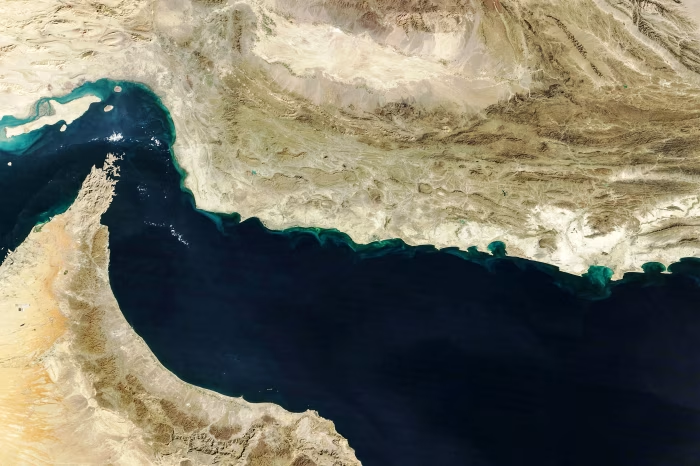
The recent increase in tensions in the Strait of Hormuz has compelled the global logistics operators to urgently re-plan the transport corridors and mitigate the reliance on one of the most sensitive maritime corridors in the world. To evade the forces of recent upheavals which have shaken world trade, importers and shipping firms in the Gulf are pressing desperately to use other sea routes and land bridges as well as multimodal networks to avoid the shock of the most recent upheavals, as reported by Reuters.
The Strait of Hormuz is the cause of almost a fifth of the global enhancement of crude oil, who transport more than 300,000 barrels of crude oil each day, and hence even a momentary instability would be a major threat to global supply networks. According to HKTDC Research, the rise of insurance premiums, increased freight prices, and massive delays to the vessels going through the narrow channel has been due to geopolitical unrest in the area. These threats have made companies in Asia, Europe and the Gulf to be able to diversify their logistical strategies.
In the midst of increased tension, the Gulf countries are hastening long-term bypass projects. Another news article covered by Asharq Al-Awsat tells about the desire of Saudi Arabia to become more dependent on its transcontinental logistical system that comprises the strategically planned railways, other pipelines, and inland transport channels that should ensure the flow of cargo does not stop even in the case of maritime crisis.
A few of the logistics operators are shifting to a multimodal form of transport where the goods are unloaded at a safe port and delivered by a truck network or the rail network across the stable areas. These alternative ways can save an individual more time on the road but to a great extent they enable one to escape trouble areas and unreliable shipping blocks.
In order to control the risk level that is rapidly changing, the supply chain operators are taking up high-level route-optimization systems, real-time-cargo trackers, and geopolitical-risk-analytics programs. As these adaptations will accelerate such infrastructure inflow in the Middle East and Asia, such as expansion of new ports, cross-border rail, and diversification of energy pipes, analysts reckon that such adaptations will drive up infrastructure investment.
The modern situation will bring a transformative shift in international trade policy. Supply chains are also becoming resilient and dynamic in times of geopolitical uncertainty by developing backup transportation networks, and by removing reliance on any single checkpoint.
Join Our WhatsApp Group
Click here to join our official Logistics Updates WhatsApp group


The editorial team of - Logistic Heroes news Website - managed by a group of seasoned professionals with diverse expertise in supply chain management and latest technologies using in cargo Industry. With several years of on-site experience, the team provides in-dept analysis, conducting interviews and podcasts, helping readers stay informed about the latest trends, changes and innovations in logistics Industry.